
In short: Every Wall Screen glass TV cover is built from tempered ultra-clear glass — 4–5 times stronger than ordinary glass, with polished, rounded edges — on a 27 mm birch plywood frame, structurally anchored to the wall. The glass never touches the screen and ventilation is engineered for proper heat dissipation. There is no wear: glass does not fade or yellow, so the unit always looks new. Professional installation by company employees only, with warranty and support after handover.
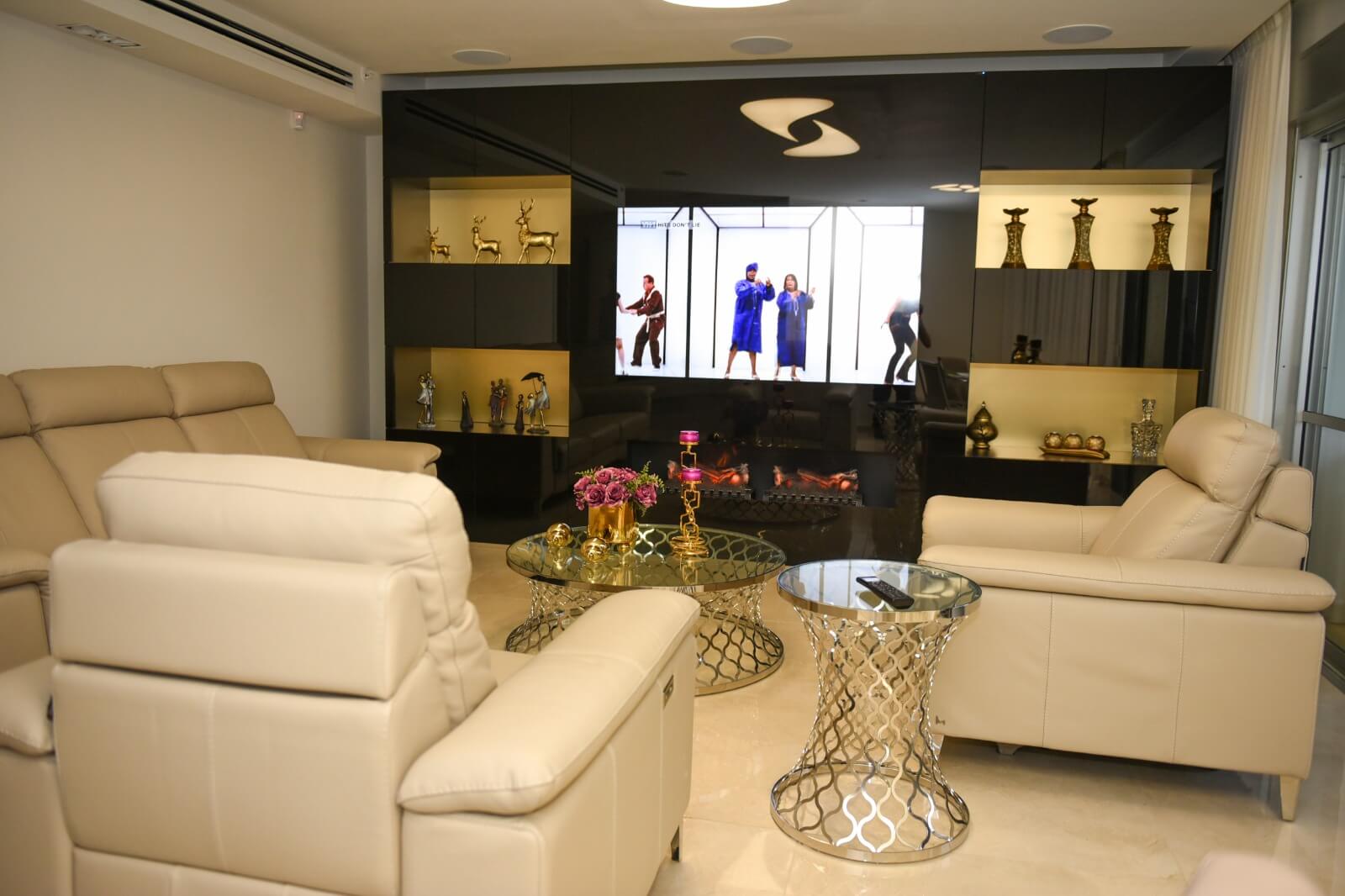
When you install a large glass panel at the centre of the living room, facing the sofa where the children sit — there is no room for compromise. That is why every Wall Screen glass TV cover is built around one principle: safety comes before design, price and schedule.
In this article we dive deep into the material itself: what really happens to glass during tempering, why edge polishing matters just as much, what makes ultra-clear (low-iron) glass special, how the unit is anchored to the wall, and why glass — the material people think of as "fragile" — is actually the safest and most durable choice for a TV wall that stays new for years.
Talk to us about your projectTempered (toughened) glass has undergone thermal tempering: the panel is heated to about 620–650°C and then rapidly, uniformly cooled with jets of air. The fast cooling locks the outer layers in compression and the core in tension — an internal structure that makes the panel four to five times stronger than ordinary glass of the same thickness.
In practice this means the panel withstands everyday knocks, temperature changes and loads that would break regular glass. And even in the very rare worst case of breakage, tempered glass does not shatter into long, sharp shards — it crumbles into small, blunt granules. This is exactly the safety principle that building standards require for glass doors, shower enclosures and commercial storefronts.
Important to understand: glass is tempered only after being cut to its final size. A tempered panel cannot be re-cut or drilled — which is why precision in measurement and fabrication, both done in-house at Wall Screen, is critical. Every panel is made for your specific unit, to the millimetre.
A cut glass edge is razor sharp. That is why every panel leaving our production undergoes full edge polishing: grinding removes the sharpness, rounds the corners and leaves a smooth, pleasant edge — even in places nobody should ever touch. With us this is mandatory, not an upgrade.
Polishing also has a hidden engineering role: microscopic flaws at a glass edge are where most breaks begin. A polished, uniform edge dramatically reduces the chance of a crack starting from the perimeter, and combined with tempering you get a panel that is very hard to damage even by accident.
The final result is felt by hand and seen by eye: a polished glass edge looks luxurious, returns light cleanly and quietly signals the manufacturing quality of the whole unit.
Even the safest glass must keep the picture perfect. Ordinary float glass contains iron that gives it a greenish tint — and in front of a TV screen that translates into a visible colour shift. That is why we use ultra-clear (low-iron) glass: its iron content is exceptionally low, its transparency higher, and the colours passing through it stay true to the source.
Combining ultra-clear glass with tempering and polishing gives you both worlds: the strongest, safest panel you can install in a living room, and the clearest, cleanest one to watch through. When a painted tone is chosen, painting on an ultra-clear base guarantees the colour arrives exact, with no green pull.
One more quiet advantage: the glass is transparent to infrared, so every remote — TV, set-top box, streamer — works through it as usual.
A glass panel plus a large TV adds up to tens of kilograms — and safety starts with what you cannot see: the frame and the anchoring. Our units are built on 27 mm multi-layer birch plywood, an exceptionally rigid and stable material that does not warp and does not "tire" under load over the years.
The unit is anchored to the wall with structural fixings matched to the wall type (concrete, block, reinforced drywall) and to the total weight of glass + screen + equipment. Installation is carried out exclusively by our own employees — the same team that knows the unit from the workshop — so there are no responsibility gaps and no "subcontractor who didn't know".
Before every installation we check the power and communication infrastructure and plan a concealed, safe cable route. The result is a quiet, stable wall — no vibration, no creaks — for years.
Modern TVs give off heat, and set-top boxes and routers even more so. Hence our first design rule: the glass never touches the screen. A planned gap is kept between panel and screen, and hidden ventilation openings in the body of the unit allow natural airflow and proper heat dissipation — even with the front closed and all equipment running.
The internal equipment bay is ventilated separately, so the set-top box, router and console run at a healthy temperature for years. This thermal design is not only about electronics reliability — it is part of safety: a product that manages heat correctly is a product that ages slowly.
And when access is needed — our unique hydraulic opening exposes everything in one movement. Read more about the hydraulic patent and full screen access.
A real living room is not a catalogue photo: balls fly, balance bikes collide, and small hands reach everywhere. This is exactly where glass cladding proves itself. The screen — the most expensive, delicate component in the room — is physically protected behind a tempered panel that absorbs the knocks of daily life in its place. Fingerprints? One wipe and they are gone.
There are no open shelves to climb, no exposed devices attracting curious hands, no dangling cables to pull. The front is completely smooth from floor level up, and the hydraulic hardware prevents slamming on fingers — the door opens and closes in a slow, controlled motion.
Many parents come to us for exactly this reason: they want a big TV, but will not compromise on their children's safety. Our unit gives them both.
Glass is one of the most durable materials in construction and design: it does not fade in sunlight, absorb humidity, yellow, peel or shift colour. While furniture, wall paint and wood cladding age within their first decade — the glass panel of the unit stays identical to installation day.
The other components are chosen for endurance too: the thick birch frame holds its geometry, the aluminium profiles of the inner door do not corrode, and the hydraulic pistons are rated for tens of thousands of open-close cycles. There are no consumable parts and no "annual service" — just a product that keeps working and looking excellent.
That is the difference between an expense and an investment: your TV wall is the focal point of the home, and it will remain a focal point that looks new — even as you replace the TV, the sofa or the wall colour around it.
Maintaining glass cladding is almost comically simple: a microfibre cloth and standard glass cleaner. No special chemicals, no polish, no hinge lubrication, no parts to replace. The sealed glass surface absorbs nothing — a stain, grease mark or fingerprint comes off in a single wipe.
Our only recommendation: avoid abrasives (steel wool, scouring powders) that could scratch any glossy surface. Beyond that — the unit simply asks nothing of you. This is probably the shortest "maintenance plan" you will ever read.
| Mechanical strength | Tempered: 4–5× stronger than ordinary glass of the same thickness |
| Breakage mode (worst case) | Tempered: small blunt granules · Ordinary: long, dangerous shards |
| Heat resistance | Tempered: withstands high temperature differentials · Ordinary: sensitive to thermal shock |
| Transparency (ultra-clear) | No greenish tint — faithful screen colours; ordinary glass pulls green |
| Edges | At Wall Screen: full polishing and rounding of every edge — mandatory standard |
| Fit for a living room | A large panel facing a seating area demands safety glass — as in shower enclosures and glass doors |
| Glass | Thermally tempered ultra-clear (low-iron); polished, rounded edges |
| Frame | 27 mm multi-layer birch plywood — rigid, stable, no warping |
| Anchoring | Structural, matched to wall type and total weight |
| Thermal design | Glass never touches the screen; built-in ventilation for unit and equipment bay |
| Opening | Hydraulic pistons with controlled stop — no slamming |
| Wear | None: the glass does not fade, yellow or peel; the unit always looks new |
| Maintenance | A wipe with glass cleaner; no periodic treatment |
| Installation | Company employees only — from workshop to your wall |
| Warranty | On product and installation, itemised in the quote |
When you choose a Wall Screen glass TV cover, you get a product built first of all around the people who live in front of it: tempered, polished glass that is hard to damage and easy to live with, a frame and anchoring that confidently carry tens of kilograms, correct thermal design, and a hydraulic opening that prevents the small accidents of daily life.
And because there is no wear — that peace of mind does not erode with time. The unit installed in your home this year will look and function the same a decade from now. Want to know how this would work in your living room? Leave your details and we will come back with professional answers — no pressure, no commitment.
"Glass is fragile" — true for ordinary window glass, not for tempered glass. A tempered panel at the thickness we use shrugs off a ball, an elbow or a flying toy. The same material is installed in storefronts, railings and shower enclosures — environments with far more abuse than a home living room. "The glass will create annoying reflections" — correct planning of tone, finish and lighting eliminates most reflections, and while watching, the lit screen "wins" over any reflection. Thousands of customers watch through our glass every evening without thinking about it twice.
"It will overheat and shorten the TV's life" — the opposite: the planned gap, ventilation openings and heat dissipation keep a healthy operating temperature, and the glass actually protects the screen from dust and from direct-cleaning damage. "A child could break it" — statistically, the real risk in a living room is the exposed TV: a screen that gets knocked over or scratched. With us the screen is protected, anchored and covered — the safest configuration there is.
"You can't clean between the glass and the screen" — you can, easily: the hydraulic opening exposes the inner side of the glass and the screen for a one-minute wipe. These myths were born from old, improvised solutions; a properly engineered product simply does not suffer from them.
In Israel, safety glazing in construction is governed by the national glazing standard (SI 1099), which defines where safety glass is mandatory — for example large panels at low height and areas where people may collide with the glass. A large glass wall facing a seating area is exactly the kind of application that deserves the same seriousness, even when it is a furniture unit rather than a building element.
Our standard is therefore fixed and non-negotiable: tempered glass only, at a thickness matched to the panel dimensions; full polishing of every edge; structurally calculated anchoring; and planned ventilation gaps. These are not "premium extras" — they are the baseline every unit leaves our workshop with.
When comparing quotes, ask explicitly: glass type (tempered? ultra-clear?), thickness, anchoring method and who is responsible for installation. A serious supplier answers with numbers and documents — not with "trust us".
The Israeli climate challenges materials: direct sun through south-facing windows, high humidity along the coast, and sharp temperature swings between air-conditioning and summer heat. Glass passes through all of this unchanged: it does not fade or shift colour under UV, does not absorb humidity and does not swell — unlike exposed wood and wall paint.
The unit's frame is protected too: 27 mm multi-layer birch is far more stable than MDF or thin board, the aluminium profiles of the inner door do not corrode even in humid rooms, and the hydraulic pistons are sealed. In practice: units we installed years ago in seafront apartments look today exactly as they were handed over. That is the real meaning of "the unit always looks new" — not a slogan, but a property of the materials we chose.
Every unit passes a series of checks before leaving the workshop: glass-to-frame fit (deviations of a few millimetres are rejected), polish quality on every edge, colour uniformity across the whole panel, piston calibration to the exact weight, and full open-close cycle testing. Only a unit that passes everything is packed for transport.
At installation a second check is performed, this time in real conditions: precise levelling, anchoring strength on your specific wall, lighting and remote operation, equipment-bay temperature after an hour of operation, and full-range front movement. And because the manufacturer, installer and warranty provider are the same body — there is no musical chairs of responsibility. One address, one team, one standard. That is what safety looks like when it is a method, not a slogan.
"My son throws a ball at the wall. Is that really OK?" — Yes. A tempered panel at the thickness we install absorbs everyday knocks easily; a household ball does not come near the breaking threshold. And unlike an exposed TV — which such a ball can genuinely destroy — here the screen is fully protected. "What about fingers in the door?" — The hydraulic pistons prevent slamming: closing is slow and controlled, with no exposed pinch points, and there is no handle or mechanism a child could trigger by accident.
"And the electricity?" — All connections are inside the unit, behind a closed front. No exposed sockets at child height, no cables to pull, no power strips on the floor. Bottom line: a closed glass unit is probably the safest TV configuration for a home with children — safer than a TV on a stand, on an open wall or inside an open cabinet.
Quite the opposite. We use only tempered glass — 4–5 times stronger than ordinary glass — with polished, rounded edges. Even in the rare case of breakage it crumbles into blunt granules rather than sharp shards, exactly like a standard shower enclosure or glass door.
Tempered glass is heated to about 650°C and rapidly cooled, locking its surface in compression. The result: 4–5× strength, resistance to thermal shock, and a safe granular break in the worst case. Ordinary glass breaks into sharp shards and is unsuitable for a large panel in a living room.
Ultra-clear (low-iron) glass has exceptionally low iron content — none of the greenish tint of ordinary glass. In front of a TV screen this is critical: colours pass through faithfully and the picture stays sharp and clean.
No. The glass never touches the screen, a planned gap with concealed ventilation openings provides proper heat dissipation, and the equipment bay (set-top box, router) is ventilated separately. Everything runs at a healthy temperature even with the front closed.
No. Glass does not fade in the sun, yellow, absorb humidity or peel. That is the great advantage of the material: the unit looks new even after many years, with no treatment at all.
A microfibre cloth and ordinary glass cleaner — that is all. Just avoid abrasives. No other periodic maintenance is needed.
Company employees only, never subcontractors. The team that fabricates the unit in our workshop is the same team that anchors it to your wall, conceals the cabling and hands over a finished, safe product — usually within one working day.
We accompany every customer after handover, with a warranty on both product and installation. And thanks to the hydraulic patent — in most cases you can open the front and handle anything equipment-related yourself, without waiting for anyone.
Leave your details and we will get back to you with a personal quote for a glass TV cover — from planning to after-sales care.