
In short: In a Wall Screen glass TV cover, the set-top box, router and streamer are stored inside the unit in a dedicated ventilated bay, and all power, HDMI and network cables run through concealed channels. From outside you see only clean ultra-clear glass. Remotes work through the glass (infrared transparency), decorative lighting switches on and dims by wireless remote, and when access is needed — the front opens on hydraulic pistons in one movement. A wall that stays clean not just on installation day, but for years.
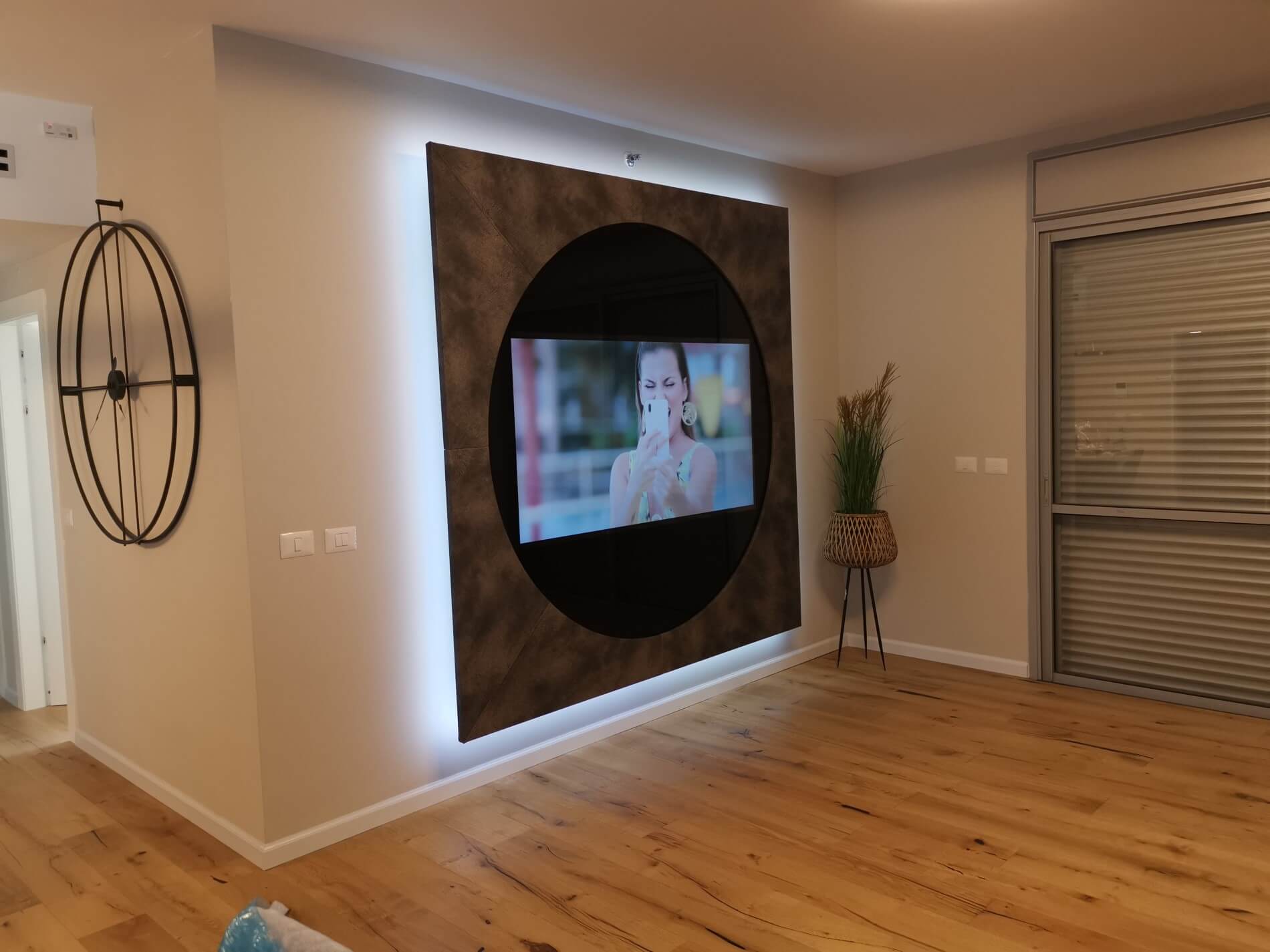
Set-top box, router, streamer, console, amplifier — and around them a tangle of power, HDMI and network cables. The average TV corner is the busiest corner of the home. Yet at Wall Screen customers' homes you see only one thing: a single clean glass surface with a soft halo of light.
The secret is planning: our unit does not "hide" the mess — it eliminates it at the root. Every device gets a dedicated bay inside the unit, every cable runs through a concealed channel, and the decorative lighting switches on with a wireless remote. In this article we show how to build a TV wall that is both the technology hub of the home and the quietest, cleanest element in the living room.
Get a Personal QuoteEven in beautifully designed homes, the TV wall tends to collapse into the same picture: a black screen on a wall, a sideboard beneath it, and on it — or inside it, behind the glass doors of a cabinet — a pile of blinking devices. Power and HDMI cables climb from the sideboard to the screen, sometimes joined by network and optical cables. Every new addition (streamer, soundbar, console) adds another wire to the picture.
The improvised solutions are familiar: plastic trunking that tries to "blend" into the wall, holes in drywall, cable trays behind the sideboard. They help — until a device is replaced, and everything is opened up again. The problem is not untidiness; the problem is that the wall was never designed to contain the whole system.
Our approach is the opposite: instead of hiding after the fact, we plan in advance. The unit is built around the screen, the equipment and the cabling — as one complete system behind glass.
Every Wall Screen glass unit includes a dedicated equipment bay: a ventilated internal shelf housing the set-top box, router, streamer, console and any accessory. The bay sits inside the body of the unit — completely hidden from view, yet fully reachable when the hydraulic front opens.
Ventilation is engineered so the equipment runs at a healthy temperature even with the front closed, and the router's Wi-Fi coverage is not affected. Remotes? They work as usual: the glass is infrared-transparent, so you change channels, adjust volume and drive the streamer without opening anything.
And when you do need to touch the equipment — restart the router, swap the set-top box, plug in a console — the hydraulic opening exposes everything in one movement. Read more in the hydraulic patent: full access to the screen.
At the planning stage we map the wall's entire cabling system: power for the screen, the equipment and the lighting; HDMI from the devices to the screen; wired network for the router and streamer; audio connections. All routes run through dedicated channels inside the unit's birch frame — not on the wall and not inside it, but within the body of the unit itself.
During installation, our company team connects everything, dresses each cable into its channel, and leaves free sockets ready for future additions. The result from outside: zero wires, zero plastic trunking, zero improvisation. The result inside: an orderly system that is a pleasure to maintain, where every cable is reachable and labelled.
The big advantage shows later: when a new device enters the home, there is no drilling, threading or hiding — you open the front, plug into a free socket, and return the cable to its channel. Two minutes, and the wall is as clean as ever.
The component that turns the wall from impressive to wow is the lighting. Our units integrate hidden perimeter decorative lighting — a soft halo surrounding the glass that creates a striking floating effect. Switching on, off and dimming are done with a dedicated wireless remote, without leaving the sofa.
Perimeter bias lighting also has a well-known functional role: when watching in a dark room, gentle backlight behind the screen softens the contrast and reduces eye strain. You get a more pleasant cinema experience and an architectural lighting element that flatters the whole living room — two benefits in one mechanism.
Because the lighting infrastructure is also fed from inside the unit, there is no visible power supply and no extra cable on the wall.
A clean TV wall changes the reading of the entire space. Without the visual noise of devices and wires, the eye rests on a simple composition: a glass surface in the colour you chose — deep black, graphite, cream or any other shade — surrounded by a halo of light. The living room looks bigger, quieter and more expensive.
This is also why architects and interior designers like working with us: the unit gives them full control of the design language — the glass can be combined with architectural concrete, with an electric fireplace beneath the screen, or with surrounding carpentry — and everything stays clean, because the entire infrastructure lives inside the unit.
Looking ahead: a designed, clean wall is an asset when selling a home. Buyers remember the living room with "that amazing wall" — not the one with the cables.
Our promise is not just a clean wall on installation day — but a wall that stays that way. The tempered ultra-clear glass does not fade, yellow or wear; one wipe with a cloth restores its brand-new shine. The 27 mm birch frame keeps everything stable, and the hydraulic mechanism keeps working smoothly after thousands of openings.
The internal order lasts too: because every device has a place and every cable has a channel, the clutter has nowhere to return to. That is the difference between "we tidied the corner" and a properly engineered wall — the first lasts a month, the second lasts years. The unit always looks new.
| The screen | Sits behind ultra-clear glass — disappears when off, razor sharp when on |
| Set-top box / router / streamer | In a ventilated equipment bay inside the unit — hidden and reachable |
| Power / HDMI / network cables | In concealed channels within the unit — zero visible wires |
| Remote controls | Work through the glass (infrared transparency) — no need to open |
| Lighting | Perimeter, hidden, wireless-remote controlled including dimming |
| Maintenance access | Full hydraulic opening in one movement — no technician |
| Future additions | Free sockets and ready channels — a new device connects in minutes |
| Routine cleaning | A cloth and glass cleaner — one smooth surface, no dust corners |
You can have both: all the technology you love — a big screen, streaming, gaming, fast internet — and a living room that looks like an architecture magazine. The wall just needs to be planned as one system, and that is exactly what we have been doing for more than a decade.
Want to see how it would look in your home? Leave your details for a free consultation, or go deeper with the complete guide to glass TV covers.
A clean wall starts with correct infrastructure. In every project we define three points in advance: power — a double socket within the unit's footprint, feeding the screen, the equipment bay and the lighting; communication — a wired network point (recommended) for the router or streamer, for a stable connection that does not depend on Wi-Fi; audio — conduit or a channel for the future connection of a soundbar or audio system, even if you have not bought one yet.
In new construction or renovation we give the electrician an exact positioning drawing — height, distance from the corner, and a description of each point. In an existing apartment? In most cases the existing points are enough: the unit is planned around them, and our internal cabling bridges the distances inside the body of the unit, without opening walls. The key principle: plan the infrastructure once, correctly — then forget about it for a decade.
The bigger the entertainment system, the more the advantage of centralised planning shows. A soundbar integrates below the screen in a planned position, with fully concealed power and HDMI-ARC routing. A home cinema system — the amplifier and streamer sit in the ventilated equipment bay, and speaker cables exit the unit at concealed points defined during planning. Gaming — a console (or two) in the equipment bay, with ventilation sized for a full evening of play.
Every device gets a dedicated socket, every cable its own channel, and everything is reachable through the hydraulic opening — including swapping a disc or plugging in a wired controller. No pile of devices on a sideboard, no "tower" behind the TV, no performance compromises. And when you upgrade a component — a new amplifier, a new console — the system is built to absorb it. Open, swap, close. The wall never knows anything happened.
Before: a black screen on the wall, a crowded sideboard beneath it, three or four blinking devices, a braid of cables climbing to the TV, and plastic trunking trying to blend into the wall colour. Every guest sees the technology first — and the design second. After: one glass surface in the tone you chose, a soft halo of light, and nothing else. The sideboard is freed (or gone entirely), the floor is clear, and the eye rests.
The change is felt in daily function too: no more dust gathering between devices and cables, no "don't touch that" zones for children, and the weekly cleaning of the TV area drops from fifteen minutes to a thirty-second wipe of glass. Customers tell us the biggest change is psychological: the living room feels calm. When the visual noise disappears, the whole room breathes differently. Hard to explain in a photo — very easy to feel at home.
Our unit integrates naturally into a smart home. The decorative lighting is operated by its dedicated wireless remote and can also be tied into your existing smart-home system — so a "movie night" scene can dim the room lights and switch on the wall's halo in one press. The equipment in the bay — streamer, set-top box, console — continues to be controlled from your usual apps and remotes, through the glass.
The wired network point in the equipment bay guarantees stable 4K streaming, and the router is positioned so wireless coverage of the home is fully preserved. For automation enthusiasts, smart sockets can be added inside the bay — for scheduled power-cycling or consumption monitoring — and everything stays hidden. Our principle is simple: your technology advances every two years — the wall should absorb it without changing. That is why we build flexible infrastructure, not a point solution.
Ever tried adhesive plastic trunking? You know the ending: the adhesive gives up in summer heat, the trunking warps, and its colour never truly matches the wall. Holes in drywall? They work until you replace the TV with one whose ports sit elsewhere. A decorative "cable box"? One more object on the floor gathering dust.
The shared problem: they treat the symptom (a visible cable) instead of the root (a wall never planned as a system). The moment you add a device, switch providers or upgrade the screen — the point solution collapses and you start over. A small cost each time, accumulating into real money and real frustration. A glass cladding unit solves the root: the whole infrastructure lives inside one engineered product, built in advance to absorb change. You pay once for a real solution — instead of ten times for plasters. Start with the complete guide and plan it right from day one.
Living room: the flagship unit — a large screen, an optional fireplace, perimeter lighting and the whole entertainment stack in the equipment bay. Bedroom: a unit in a calm tone and matte finish, with gentle night lighting controlled from bed; the screen disappears when not watching and the room stays quiet and clean. Home office: a screen serving both computer and viewing, with the router and network equipment in a ventilated bay — one clean endpoint for the home's entire communication infrastructure.
Playroom / teen room: consoles and controllers inside the unit, the screen protected from balls and enthusiasm — the room's natural mess never touches the wall. In every room, the same principle: screen and equipment inside, cables in channels, design outside. Many customers start with the living room and, after seeing the result, order a second unit for the bedroom — and since your project file is already with us, the second process is even shorter.
Perimeter lighting has a language of its own. Warm light (2700–3000K) — the classic living-room choice: enveloping, homely, flattering to wood and cream tones. Neutral light (4000K) — modern and clean, beautiful with grey and graphite glass and sharp architectural lines. Dimming — as important as the tone: during a film you want only a subtle halo, while hosting you can raise the intensity until the wall becomes an ambient light fixture.
In planning we match the lighting to your chosen glass tone: dark glass "absorbs" light and asks for more intensity; light glass reflects and needs little. The strip positions are planned too — full perimeter for a floating effect, or top-and-bottom for a clean horizontal line. And everything, of course, on one wireless remote: on, off and dim without leaving the sofa. Good lighting is the kind you feel — not the kind whose source you see.
"I already have furniture — will the unit fit?" Absolutely. We plan the unit's dimensions, height and tone around what exists: a sideboard that stays, a sofa that sets viewing height, a rug that dictates the palette. "My wall is narrow / has a window / a corner?" Every unit is fully custom-built — including non-standard walls, existing niches and challenging corners.
"Can I skip the sideboard entirely?" That is exactly the beauty: since all equipment lives inside the unit, the sideboard becomes a design choice rather than a necessity — a living room without one gains precious metres. "What about my existing TV?" It is measured and fitted into the unit; and when you replace it in the future, the hydraulic opening turns the swap into a matter of minutes. Have a question of your own? That is what the consultation is for — talk to us.
Inside the unit itself: it includes a ventilated equipment bay housing the set-top box, router, streamer and console. They are fully hidden from view and fully reachable when the hydraulic front opens.
Correct. All cabling — power, HDMI, network and audio — runs through concealed channels inside the body of the unit. From outside you see only a clean glass surface: no wires, no plastic trunking, no improvisation.
Our glass is transparent to infrared, so every remote works through it as usual — TV, set-top box and streamer. There is no need to open the front to change a channel.
No. The equipment bay is designed so the Wi-Fi signal passes freely and the router keeps covering the home as usual. For special cases we can plan a dedicated solution at the measurement stage.
With a dedicated wireless remote: on, off and dimming — all from the sofa. The hidden perimeter lighting creates a luxurious floating effect and also reduces eye strain when watching in the dark.
You open the hydraulic front, plug into a pre-prepared free socket, dress the cable into its channel and close. Two minutes — and the wall stays exactly as clean as it was.
No. The bay is ventilated with a dedicated heat-dissipation design, so the set-top box, router and console run at a healthy temperature even through long viewing sessions with the front closed.
Absolutely. At the planning stage we allocate position, sockets and cable routing for a soundbar or amplifier, so the audio system joins the wall without a single visible wire.
Leave your details and we will get back to you with a personal quote for a glass TV cover — from planning to after-sales care.