
In short: In most "TV behind glass" solutions the glass is fixed — and any access to the screen requires a technician. Wall Screen's exclusive patent solves this: the glass front is mounted on an inner aluminium door that opens on hydraulic pistons and dedicated hinges. One-hand opening, full access to the screen, set-top box, router and every connection — no tools, no service call. The mechanism is rated for tens of thousands of openings, built on a 27 mm birch frame, and needs zero maintenance. Only we make it.
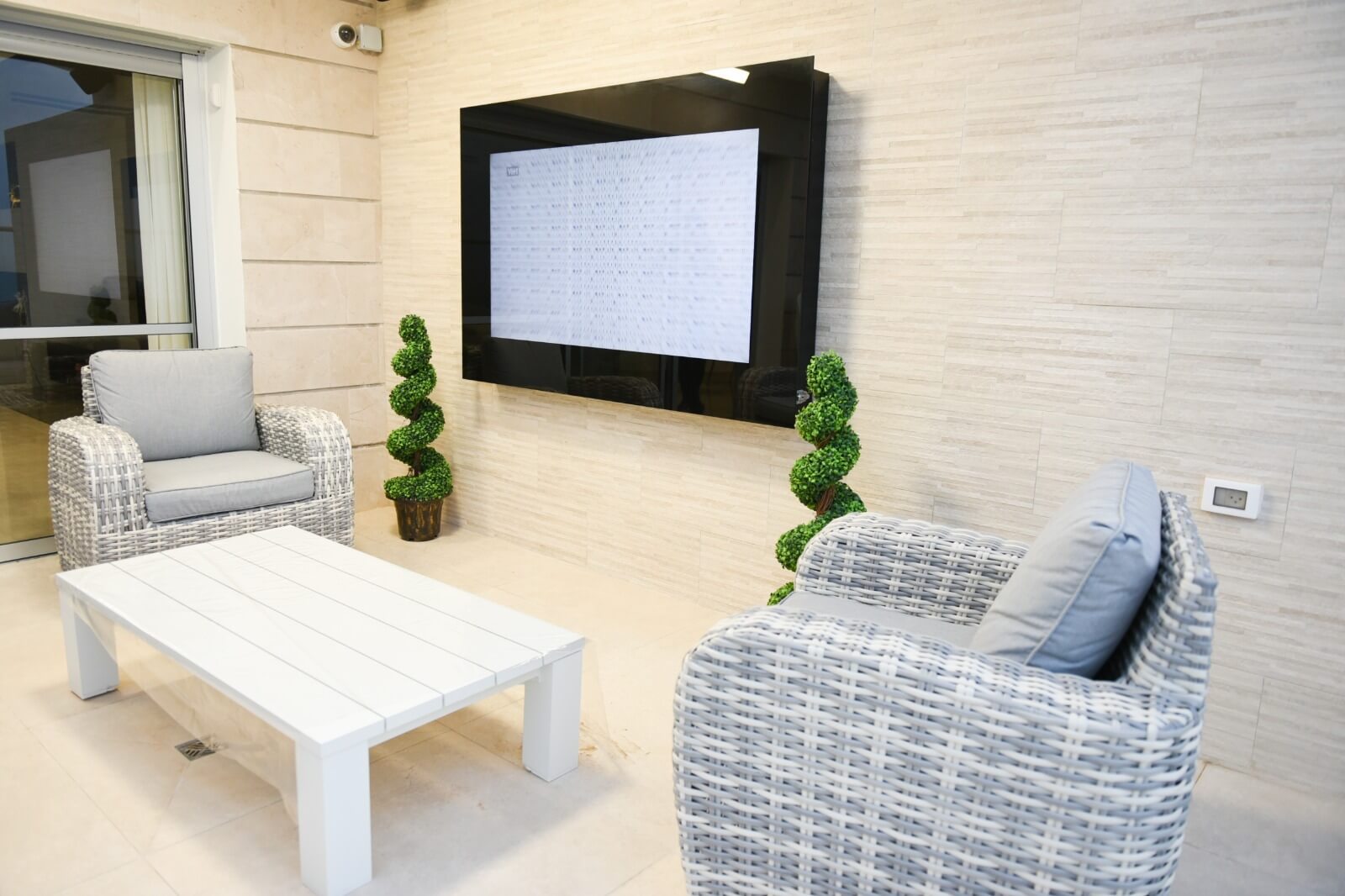
Every "TV behind glass" solution sounds great — until the moment you need to reach the screen. To swap a set-top box, plug in a console, change a connection. In most solutions on the market the glass is fixed to the wall, and every such action means a technician visit and dismantling. With us it works differently.
Wall Screen developed a unique mechanism — a patent only we manufacture: the glass front is built on an inner aluminium door that opens by means of hydraulic pistons and dedicated hinges. In one soft movement the entire front opens, giving you full access to the screen and all the equipment — no tools, no technician, no dependence on anyone. In this article we explain exactly how it works and why it changes the whole ownership experience.
Book a DemonstrationLet us be honest: the idea of hiding a TV behind glass is not exclusive to us. But in most implementations you will meet — carpentries gluing a glass panel onto a cabinet front, or walls where the glass is screwed and siliconed in — there is a built-in problem: the screen and the equipment are locked in. Every upgrade, every minor fault, every new cable becomes a project.
Think about the real life cycle of a TV corner: the content provider and its box change every few years, a streamer gets added, a new console arrives, and sometimes you simply need to unplug and replug an HDMI cable. With fixed glass, each of these actions = scheduling a technician, waiting, paying, and risking damage during dismantling.
That is why, when we designed our units, the starting point was not "how do we hide the screen" but "how do we give the customer full access to the screen — without giving up the perfect concealment".
Our solution is built from three engineering layers working together. An inner aluminium door: the glass front is not glued to the wall but mounted on a rigid, light aluminium frame that functions as a true door. Aluminium does not corrode, does not warp, and safely carries the weight of the glass for years.
Dedicated hinges: the door is connected to the body of the unit with industrial hinges calibrated to the specific weight of your glass. Hydraulic pistons: a pair of gas-hydraulic pistons lifts the front in a slow, controlled motion, holds it open with complete stability at any angle, and returns it gently into place — no slam, no effort. If you have ever opened a modern kitchen lift-up door you know the feeling — only here it is an entire glass front.
Opening requires no strength: one hand is enough. And with the front open — the screen, the HDMI ports, the power, the set-top box, the router and the entire equipment bay are exposed and reachable at a comfortable height.
The meaning of the patent is simple: you do not depend on us — or on any technician — for any routine action. Want to connect a new Apple TV? Open, plug, close. The cable company replaced its box? Two minutes. Need to restart the router? It sits at hand height, behind a front that opens in one movement.
Even replacing the TV itself — something everyone does every few years — becomes far simpler: the front opens fully and gives comfortable access for mounting, and as long as the size class is kept, the new screen fits the same unit exactly. Your unit does not "age" with the TV — it carries on with you to the next generation of screens.
And of course, cleaning: every so often you can open, wipe the inner side of the glass and the screen, and close. Full control, zero dependence, zero service calls — we call that quiet ownership.
Our hydraulic opening mechanism is the product of years of development, built around three engineering challenges that are hard to solve together: weight (a large tempered glass panel weighs tens of kilograms), precision (the glass must return to exactly the same plane, on every opening, for years) and safety (the front must stay open stably and descend gently).
The solution requires precise calibration of piston force against the weight of the specific glass, an engineered aluminium frame, and a 27 mm birch skeleton that does not move a millimetre under cyclic load. This is exactly why we fabricate everything ourselves, in our own workshop, rather than buying an off-the-shelf "solution": every unit is individually calibrated.
When comparing quotes, ask one simple question: "How do I access the screen after installation?" — the answer will instantly tell you who you are dealing with.
The hydraulic opening is the gateway to a remarkably tidy world. Behind the glass, inside the unit, sits a dedicated ventilated equipment bay housing the set-top box, router, streamer, console and anything else you need — fully hidden, wired through concealed channels, reachable with one opening. Remotes work through the glass (full infrared transparency), so day to day there is no reason to open at all.
The decorative lighting, operated by wireless remote, is also fed from concealed internal wiring. From the outside: one clean sheet of glass. From the inside: exemplary order that is easy to maintain. We expand on this in a clean TV wall — no cables, no visible devices.
And when a new device enters the house? It already has a place ready, a free socket and an orderly channel. The unit was designed in advance for a life that changes.
A mechanism that opens and closes must be exceptionally durable — otherwise it becomes the product's weak point. That is why every opening component is selected from industrial-grade raw materials: gas-hydraulic pistons rated for tens of thousands of cycles, calibrated hinges, and aluminium profiles that neither corrode nor fatigue.
Combined with the 27 mm birch frame, which keeps the unit's geometry perfectly stable, you get a mechanism that feels on its 1,000th opening exactly as on its first: soft motion, stable stop, precise closing. No creaks, no sag, no re-adjustments.
This is part of our overall "zero wear" promise: just as the glass does not fade and the carpentry does not warp — the mechanism does not wear out. The unit looks and functions like new, year after year.
| Fixed glass (glued/screwed) | Any access to the screen requires a technician and dismantling; risk of damage every time |
| Cabinet with regular doors | Side doors need swing clearance, hide the screen only partially and expose hardware; reads as "furniture", not a wall |
| Sliding mechanisms | Visible tracks, dust traps, and the glass never sits perfectly flush with the wall |
| Motorised TV lift | Expensive, noisy motorised mechanism, power-dependent, an electro-mechanical point of failure |
| The Wall Screen patent | Glass front on an aluminium door + hydraulic pistons: one-hand opening, full access, zero technician dependence, a perfect wall look |
| Mechanism type | Inner aluminium door carrying the glass front — exclusive Wall Screen patent |
| Drive | A pair of gas-hydraulic pistons calibrated to the glass weight |
| Hinges | Dedicated industrial hinges, calibrated per unit |
| Opening | One-handed, controlled motion; the front stays open stably |
| Closing | Soft and precise, no slamming — child-safe |
| Access | Screen, HDMI, power, set-top box, router, equipment bay — everything reachable |
| Durability | Rated for tens of thousands of cycles, no re-adjustment |
| Maintenance | None required; the mechanism needs no lubrication or care |
The difference between a good product and an excellent one is what happens after installation. Our hydraulic patent is the guarantee that your investment will not turn into dependence: your glass wall will look perfectly sealed — and remain completely accessible, to you and only you.
Want to feel the opening with your own hands? Book a meeting — we will gladly show you the mechanism up close and fit a unit to your living room. You can also start with the complete guide to glass TV covers.
Friday evening, 8pm. The set-top box freezes mid-match. Instead of calling a hotline and waiting for a Tuesday technician — you open the front, power-cycle the box, close. Ninety seconds, and the game is back. A child's birthday. You bought a new console and he wants to play now. Open, plug the HDMI into the pre-prepared free socket, dress the cable, close. Installing the gift took less time than unwrapping it.
Switching internet providers. The provider's technician needs the router? You open the front and everything is in front of him, at a comfortable height in good light. He finishes faster, and you do not need to "dismantle the living room". Spring cleaning. Every few months, open and wipe the inner side of the glass and the screen. Five minutes, and everything shines like handover day.
Each of these moments is small on its own — but together they are the difference between a product you live with comfortably and a product you live around carefully. That is what the patent buys you: quiet.
Second 0: grip the edge of the front and pull lightly. The pistons sense the motion and start working for you — from here it feels like a front that "lifts itself". Seconds 1–3: the front rises in a controlled, uniform arc; the calibrated hinges keep a fixed path, with no side wobble and no effort on your part.
Second 4: the front reaches its full opening angle and stops there — completely stable. Nothing to hold, no support rod, no fear of a sudden drop. Now everything is in front of you: the screen, the power and HDMI connections, the equipment bay with the set-top box and router, and the lighting infrastructure. Done? A light downward pull, and the pistons escort the front in a slow descent to a quiet, precise close — the glass returns to exactly the same plane, every time.
No code, no motor, no electricity, no app — and therefore nothing to fail. Pure mechanics, individually calibrated to your unit, working the same on opening one and opening one thousand.
We work with many architecture and design studios, and these are the points that come up in every project. Opening clearance: the front opens upward — no side clearance is needed, and sofas and tables can sit close to the wall. Infrastructure: a power point and a communication point are required within the unit's footprint; we provide an exact positioning drawing at the planning stage, so the electrician finishes before we arrive.
Weights and anchoring: we calculate the anchoring per wall type (concrete, block, reinforced drywall) and provide strengthening requirements where needed. Design freedom: the mechanism does not dictate the look; the glass can be any tone and finish, combined with concrete, wood or a fireplace, and the front stays free of handles and visible hardware. The earlier you bring us into planning, the smoother the result — the wall is built right from the foundation and the unit fits it like a glove.
The beautiful paradox of our patent: the more sophisticated the engineering, the less you see it. With the front closed there is no hint of a mechanism — no visible hinges, no handles, no uneven gaps. The glass appears to float on the wall, and the eye reads one continuous clean surface.
This is achieved through three design principles: the hinges and pistons all sit inside the body of the unit, behind the plane of the glass; the perimeter gap is uniform and minimal, calibrated at installation; and opening is done by gripping the front directly — no handle to break the line. Even the perimeter lighting is concealed so you see only the light, never the fixture. The result: guests do not realise there is a door at all — until you open it in one movement, and then comes the standard reaction: "Wait, the whole wall opens?!" Yes. The whole wall opens.
The patent was not born on a drawing board — it was born in customers' living rooms. In Wall Screen's early years, installing first-generation glass units, we heard the same sentence again and again: "Stunning. And what do we do when we need to reach the TV?" The answers that existed in the market — partial dismantling, hidden screws, a technician — were not good enough for us. We knew that until we solved the access question completely, the product would forever remain "beautiful, but…".
We tried different routes: standard hinges buckled under the glass weight or demanded unreasonable opening force; motorised mechanisms added noise, cost and power dependence; sliding solutions left visible tracks. The breakthrough came from the combination: a rigid, light aluminium door carrying the glass, and gas-hydraulic pistons individually calibrated to the weight — so the front "floats" in your hand and stays open by itself. Years of refinement followed — finer calibration, stronger hinges, tighter gaps — but the principle remains the one born from our customers' question. And it is still exclusive to us.
Customers used to other products ask us when the mechanism needs "renewing", "lubricating" or "recalibrating". The answer surprises them: never. The pistons are sealed and calibrated for life; the hinges need no lubrication; the birch frame does not move; and the glass — as we wrote — does not wear. There is no treatment list, no service subscription, no follow-on costs.
The only thing the unit asks of you: wipe the glass when you feel like it (outside — whenever; inside — open and wipe a few times a year). That is the entire "maintenance plan". And if a rare question or fault does arise — our warranty covers the product and the installation, and the team that built your unit is available to you. A properly engineered product does not need ongoing attention — it simply works.
The unit's glass front is built on an inner aluminium door that opens by means of hydraulic pistons and dedicated hinges. One light movement opens the entire front and gives full access to the screen and equipment — a solution only we manufacture.
No. That is exactly the point of the patent: you open the front with one hand, connect or replace whatever is needed, and close. No tools, no service call, no dependence on anyone.
Opening is light and controlled — the pistons do the work. Closing is soft with no slam, so there is no danger to fingers. The mechanism is calibrated to the specific weight of your unit's glass.
The pistons and hinges are rated for tens of thousands of cycles — far beyond any reasonable home use. The mechanism needs no lubrication or care, and does not sag or creak over the years.
Yes. The front opens fully and gives comfortable access for taking down the old screen and mounting the new one. As long as the size class is kept, the new TV fits the same unit — and the unit continues with you for years.
Our glass is transparent to infrared, so every remote — TV, set-top box, streamer — works through it as usual. Day to day there is no need to open the front at all.
Yes. We build units for screens from 55 to 85 inches and beyond. In every unit the pistons and hinges are re-calibrated to the specific weight and dimensions — which is why every unit is custom-made.
We provide a full warranty on the product and the installation, and our service accompanies you after handover. The team that built your unit is the team that maintains it — company employees only.
Leave your details and we will get back to you with a personal quote for a glass TV cover — from planning to after-sales care.