
In short: A glass TV cover is a custom unit in which the screen sits behind tempered, polished ultra-clear glass: with the TV on, the picture is perfectly sharp; with it off, the wall reads as a designed glass surface. The frame is 27 mm birch plywood, the front opens on hydraulic pistons with an inner aluminium door (our exclusive patent) for full screen access without a technician, the set-top box and router are stored inside, decorative lighting switches on by remote — and there is no wear: the unit always looks new. Installed by company employees only, short lead times, fair prices, any colour you choose. Active for more than a decade.
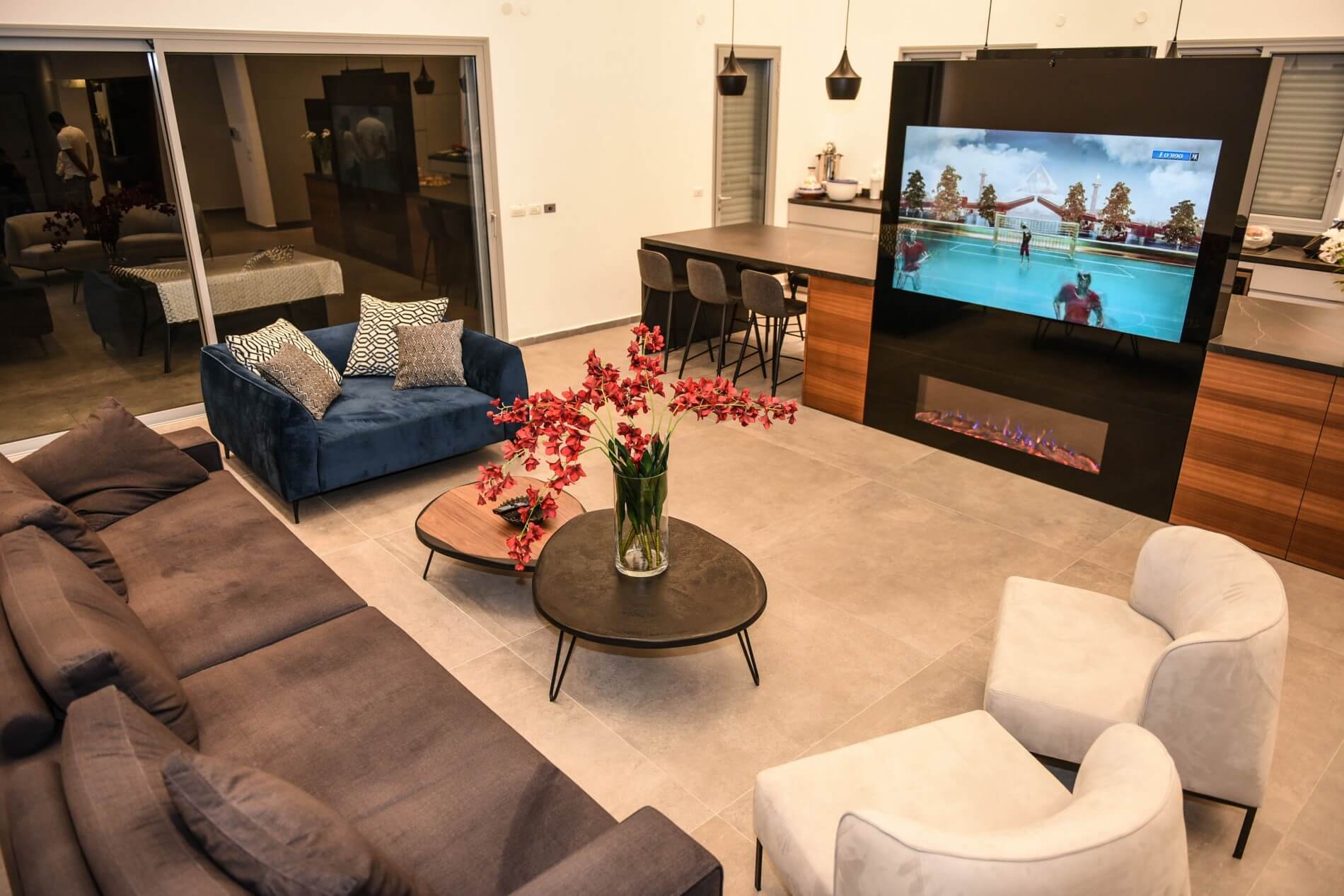
A glass TV cover (glass TV wall cladding) is a custom-built architectural unit in which the television sits behind a panel of tempered, polished ultra-clear glass. When the screen is on, the picture is perfectly sharp — as if there were no glass at all; when it is off, the wall becomes a designed glass surface with no black rectangle, no cables and no visible devices.
This is not a simple "cover" or a decorative frame: it is a complete system built from 27 mm birch plywood carpentry, an inner aluminium door that opens on hydraulic pistons, a concealed compartment for the set-top box and router, decorative lighting operated by a wireless remote — and professional installation carried out exclusively by our own company team. In this guide we cover everything: structure, materials, safety, process, price, and why the unit still looks brand new years later.
Get a Personal QuoteThe television is almost always the largest, most dominant object in the living room — and when it is off, it is simply a huge black rectangle that pulls the eye and breaks any design concept. Curtains, sliding cabinets and pop-up TV lifts all try to fight this, but they add clumsy mechanisms or hide the screen even when you want to watch. Glass TV cladding solves the dilemma from the opposite direction: the screen stays exactly where it is, and only its envelope changes.
Covering the TV screen with decorative glass creates a double effect: while you watch, the glass "disappears" and you get a full, sharp picture; when the screen is off you are left with a luxurious glass wall — dark, coloured, or combined with architectural concrete — that reads as a pure design element. Guests genuinely cannot tell where the TV is until you switch it on.
Beyond aesthetics there is a practical logic: the glass protects the screen from dust, fingerprints and knocks, and what you see is always one smooth surface that is easy to clean. It is the difference between a TV wall you need to tidy before hosting — and a wall that is always ready.
Behind the minimalist look hides precise engineering. The base is a carpentry frame made of 27 mm birch plywood — an exceptionally stable, multi-layered hardwood board, among the strongest materials in the carpentry industry. It does not warp over time and easily carries the weight of the glass and the screen. This is not standard 17–18 mm furniture board; the thickness and strength are what keep the unit rigid and true for decades.
Onto this frame we mount a front of tempered, polished ultra-clear (low-iron) glass, in the colour and finish of your choice. Behind the glass sits an inner aluminium door that opens on hydraulic pistons and dedicated hinges, so the entire front of the unit opens in one soft movement and gives full access to the screen and the equipment — a patent that only we manufacture.
Inside the unit there is a ventilated equipment bay for the set-top box, router, streamer and any accessory, plus concealed cable routing and decorative lighting. Every component — from the hinges to the finish — is selected from premium raw materials, because the unit is built to serve you for decades.
Not every glass is suitable to stand in front of a TV screen. Ordinary float glass contains iron oxides that give it a subtle greenish tint — barely noticeable in a window, but very visible in front of a bright screen. That is why we work with ultra-clear (low-iron) glass: an extra-transparent glass with no green cast, which transmits the picture with faithful, vivid colours.
The glass is fully thermally tempered — a process that makes it four to five times stronger than ordinary glass — and every edge is carefully polished. The result is a strong, safe panel that is pleasant to touch, with no sharp corners and no rough edges. Even when a dark tone or full colour is required, the paint is applied on an ultra-clear base so the colour you choose comes out clean and exact, with no greenish shift.
Good to know: the glass is transparent to infrared, so the remote controls of the TV, set-top box and streamer all work through it freely — you never open anything just to change a channel.
The first question every customer asks is: "What happens when I need to reach the TV?" — and this is where Wall Screen differs from every other solution on the market. In most TV-behind-glass installations the glass is fixed; any fault, any new device, even a trivial cable swap means calling a technician to dismantle the wall. Not with us.
We developed a unique mechanism, a patent only we produce: the glass front is built on an inner aluminium door that opens by means of hydraulic pistons and dedicated hinges. With one light movement the front opens and stays safely open, giving you full, immediate access to the screen, the HDMI ports, the set-top box and the router — no tools, no technician, no service call.
The practical meaning is huge: switched content provider? Bought a new console? Want to plug in a streaming stick? Open, connect, close. The unit is designed so the customer stays completely independent for the entire life of the product. Read more in the hydraulic patent — full access to the screen.
A TV wall can be as beautiful as you like — one hanging cable ruins everything. When we plan the unit we allocate a dedicated bay for all the equipment: set-top box, router, streamer, game console, amplifier — all stored inside the unit itself, completely hidden from view yet reachable the moment the front opens. Ventilation is engineered so the equipment runs at a healthy temperature even with the door closed.
All cabling — power, HDMI, network, sound — is routed through concealed channels inside the body of the unit. From the outside you see no wires, no sockets and no devices: only clean glass. The router's Wi-Fi signal is not affected, and remotes keep working through the glass thanks to its infrared transparency.
If you are weighing different ways to hide cables and devices, we compared them all in a clean TV wall — no cables, no visible devices.
Our units integrate perimeter decorative lighting, switched and dimmed with a dedicated wireless remote. At the press of a button the wall gains a soft halo — a "floating" effect that highlights the glass and gives the living room flattering ambient light for hosting and viewing evenings.
Beyond beauty, bias lighting behind a screen has a well-known functional benefit: it softens the contrast between a bright screen and a dark room and reduces eye strain during long viewing. Intensity is controlled from the sofa, so it is easy to find exactly the right mood for a film, a game or a quiet evening.
We install units in homes with children, pets and busy living rooms — so safety leads the design. The glass is tempered: even in the very rare worst case of breakage it crumbles into small granules rather than sharp shards. The edges are polished and eased, the front has no sharp corners, and the carrying system is structurally anchored to the wall to suit the full weight.
The glass never touches the screen, and ventilation gaps are engineered for proper heat dissipation of both the TV and the equipment. The hydraulic pistons hold the front open firmly — no slamming, no drops. Every installation is carried out exclusively by our own employees, who know every screw in the unit.
For a deep dive into glass standards, tempering and polishing, read tempered, polished glass: safety and durability for years.
This may be the most surprising advantage of a glass TV cover: time barely touches it. Glass is an inorganic material that does not fade in the sun, does not absorb humidity or odours, does not yellow and does not peel. Unlike wooden furniture that wears, shelves that gather dust and wall paint that tires — the glass surface of the unit looks the same as on installation day, even a decade later.
Maintenance amounts to a wipe with a cloth and ordinary glass cleaner. No refinishing, no repainting, no part replacement, no periodic treatment. The thick birch frame preserves the unit's geometry, and the premium hardware is engineered for tens of thousands of open-close cycles.
As an investment it is an asset: the TV wall is the focal point of the living room, and it stays "out-of-the-box new" for years. Customers selling their homes find the unit is a genuine selling point.
No two units are identical. The colour is chosen by the customer from a wide palette — deep black, graphite, cream, white, bronze or any other shade — in gloss or matte finish. The glass can be opaque around the screen area, reflective (mirror effect), or combined with printing and textures.
The glass unit can be combined with architectural concrete cladding for a multi-material wall, or with a built-in electric fireplace below the screen — an especially popular combination that gives the living room a warm, impressive centrepiece. Supported screen sizes: 55, 65, 75, 85 inches and beyond, and every unit is designed around the exact dimensions of your wall.
We routinely work with architects and interior designers and match the unit to the design language of the home — from clean minimalism to classic luxury. See more ideas in our project gallery.
We accompany you all the way, from the first idea until long after installation. The process is simple: Consultation and planning — a meeting to understand your needs, space and style, including working with your architect or designer. Precise measurement — we measure the wall, the TV and the power and communication infrastructure. Fabrication — the unit is built for you in our own workshop from 27 mm birch and ultra-clear glass, in the colour you chose.
Professional installation — a team of company employees (never subcontractors) arrives, installs, conceals the cabling, connects the equipment and leaves a clean living room ready for viewing — usually within a single working day. Ongoing service — we remain available after installation, and thanks to the hydraulic patent you will rarely need us at all.
Our lead times are short for the industry, and our prices are fair and transparent — no surprises beyond the quote. The full step-by-step is described in from planning to installation — how a glass unit is born.
Before deciding, it is worth comparing glass cladding to the common alternatives: a drywall niche with a shelf, a closed TV cabinet, a decorative frame or a wood-panel wall. The table sums up the essential differences:
| Hiding the screen when off | Only glass hides the black rectangle completely; drywall, wood and frames leave it exposed |
| Cables and devices | In a glass unit — everything inside; open solutions need separate concealment tricks |
| Wear over the years | Glass does not fade or wear; wood and drywall need refinishing, paint and repairs |
| Access to the screen | Our hydraulic patent — full opening with no technician; other closed walls require dismantling |
| Cleaning and maintenance | A cloth and glass cleaner — that's it; other materials collect dust, stains and fingerprints |
| Design value | A luxurious surface in a personal colour that raises the property's value |
All hidden-TV approaches, with pros and cons, are reviewed in our Hebrew guide to hidden TV solutions.
| Glass | Tempered, polished ultra-clear (low-iron); colour and finish of your choice |
| Frame | 27 mm multi-layer birch plywood carpentry |
| Opening mechanism | Inner aluminium door on hydraulic pistons and hinges — exclusive patent, full access to the screen |
| Equipment storage | Set-top box, router, streamer, console — inside the unit, with built-in ventilation |
| Cabling | Power, HDMI and network — fully concealed within the unit |
| Lighting | Built-in decorative lighting, switched and dimmed by wireless remote |
| Screen sizes | 55–85 inches and beyond, precision-built for every wall |
| Remote controls | The glass is infrared-transparent — every remote works through it |
| Installation | Company employees only, no subcontractors; usually one working day |
| Lead time | Short delivery times — an exact schedule with your quote |
| Experience | More than a decade of activity and hundreds of installed units across Israel |
| Warranty & service | Warranty on product and installation + support after handover |
A glass TV cover suits anyone who wants a genuinely polished living room: families who want a clean, child-safe wall, couples renovating around an impressive centrepiece, architects and designers looking for a reliable concealment solution, and also hotels, offices and commercial spaces (see our commercial solutions).
We have been active for more than a decade, fabricate everything ourselves from premium raw materials, install only with our own employees, and accompany every customer from the first sketch until long after installation. The hydraulic patent, ultra-clear glass and 27 mm birch are not buzzwords — they are the reason our units look new years later. Want to see it up close? Book a free consultation.
Mistake 1 — choosing by photo alone. A beautiful photo does not tell you what is behind the glass: which glass it is, how the screen is accessed, where the set-top box lives and who will actually install. Always ask for a full specification and, if possible, to see a real installed unit. Mistake 2 — settling for ordinary glass. Float glass is cheaper, but its greenish tint distorts the picture, and it is not safe as a large panel in a living room. The right standard: tempered, polished ultra-clear — no shortcuts.
Mistake 3 — forgetting access. A fixed front looks the same on installation day; you discover the difference at the first technician call. Insist on a real opening mechanism — like our hydraulic patent. Mistake 4 — ignoring infrastructure. A wall without planned sockets, network and channels ends with a visible cable somewhere. Mistake 5 — buying from an installer, not a manufacturer. When seller, manufacturer and installer are one body, there is a single address for warranty and service.
The living room is the natural first home for a glass TV cover, but it works beautifully in any space where a screen "breaks" the design. In the bedroom — a unit in a calm tone turns the TV into a quiet presence that disappears when off, with no black rectangle dominating the wall facing the bed. In the home office — the screen serves both work and viewing, and the glass keeps a clean professional look on video calls.
In commercial spaces the solution is in growing demand: hotel lobbies, meeting rooms, clinics and flagship stores use our units to integrate content screens into luxury design — without the "TV on a wall" look. See our commercial solutions page. In every space the principle is the same: one screen, one glass, zero cables — and full matching of colour, finish and lighting to the character of the place.
When comparing the price of glass cladding to other solutions, compare correctly: not "what it costs today" but "what it costs over a decade". A quality TV cabinet wears out and gets replaced; a drywall niche needs repainting, repairs and sometimes rebuilding when the TV changes; motorised solutions need maintenance. Our glass unit is a one-time expense: no wear, no treatments, no replacements.
There is also value that is hard to quantify but easy to feel: a living room that looks tidy every day with no effort, hosting evenings without "one second, let me sort that corner", and a daily sense of luxury. And when the day comes to sell the home — the glass wall is one of the first things buyers remember from the viewing. Our prices are fair for the finish level, and the quote is always final and itemised.
Ultra-clear (low-iron) glass: glass with exceptionally low iron content and none of the greenish tint of ordinary glass — the correct standard in front of a screen. Thermal tempering: a heat-and-rapid-cool process that makes glass 4–5× stronger and turns worst-case breakage into blunt, safe granules. Edge polishing: grinding and rounding of every glass edge — safety and a luxurious look in one.
27 mm birch: extra-thick multi-layer birch plywood, the frame on which the unit is built — rigid, stable and durable for decades. Hydraulic piston: the gas-hydraulic mechanism that lifts the glass front gently and holds it open stably — the heart of our patent. IR transparency: the glass property that lets infrared remotes work through it. Equipment bay: the ventilated shelf inside the unit where the set-top box, router and streamer live — hidden and reachable.
It is a custom architectural unit in which the television sits behind a panel of tempered, polished ultra-clear glass. When the screen is on the picture looks perfect through the glass; when it is off the wall reads as a designed glass surface — no black screen, no cables, no visible devices.
No. We use ultra-clear (low-iron) glass with exceptionally high transparency and none of the greenish tint of ordinary glass, so the picture stays sharp and colour-faithful. The glass is also infrared-transparent, so all remote controls work through it.
That is our patent: the glass front is built on an inner aluminium door with hydraulic pistons and dedicated hinges. One movement opens the front and gives full access to the screen, the ports and the equipment — no tools, no technician, no service call.
Inside the unit. It includes a ventilated equipment bay for the set-top box, router, streamer and console, and all cabling runs through concealed channels. From the outside you see no wire and no device — only clean glass.
Yes. The glass is tempered (4–5 times stronger than ordinary glass) and polished with no sharp corners, the unit is structurally anchored to the wall, and ventilation is engineered for proper heat dissipation. Product safety leads the design.
The price depends on screen size, wall dimensions, glass type and additions such as a fireplace or concrete combination. Our prices are fair and the quote is detailed and final — no surprises.
Our lead times are short for the industry. After measurement and design approval, the unit is fabricated in our own workshop and usually installed in a single working day by company employees. An exact schedule comes with the quote.
Yes. Every unit is precision-built for your existing TV model and size — from 55 to 85 inches and beyond — and if you replace the TV in the future, the hydraulic opening makes the swap easy.
Leave your details and we will get back to you with a personal quote for a glass TV cover — from planning to after-sales care.