
In short: The Wall Screen process has six steps: consultation and planning guidance (including working with your architect), precise measurement at home, colour and finish selection to your taste, in-house fabrication in our workshop — a 27 mm birch frame and tempered ultra-clear glass, one-day installation by company employees only, and ongoing service after handover. Short lead times, fair prices and a final quote with no surprises. Active for more than a decade.
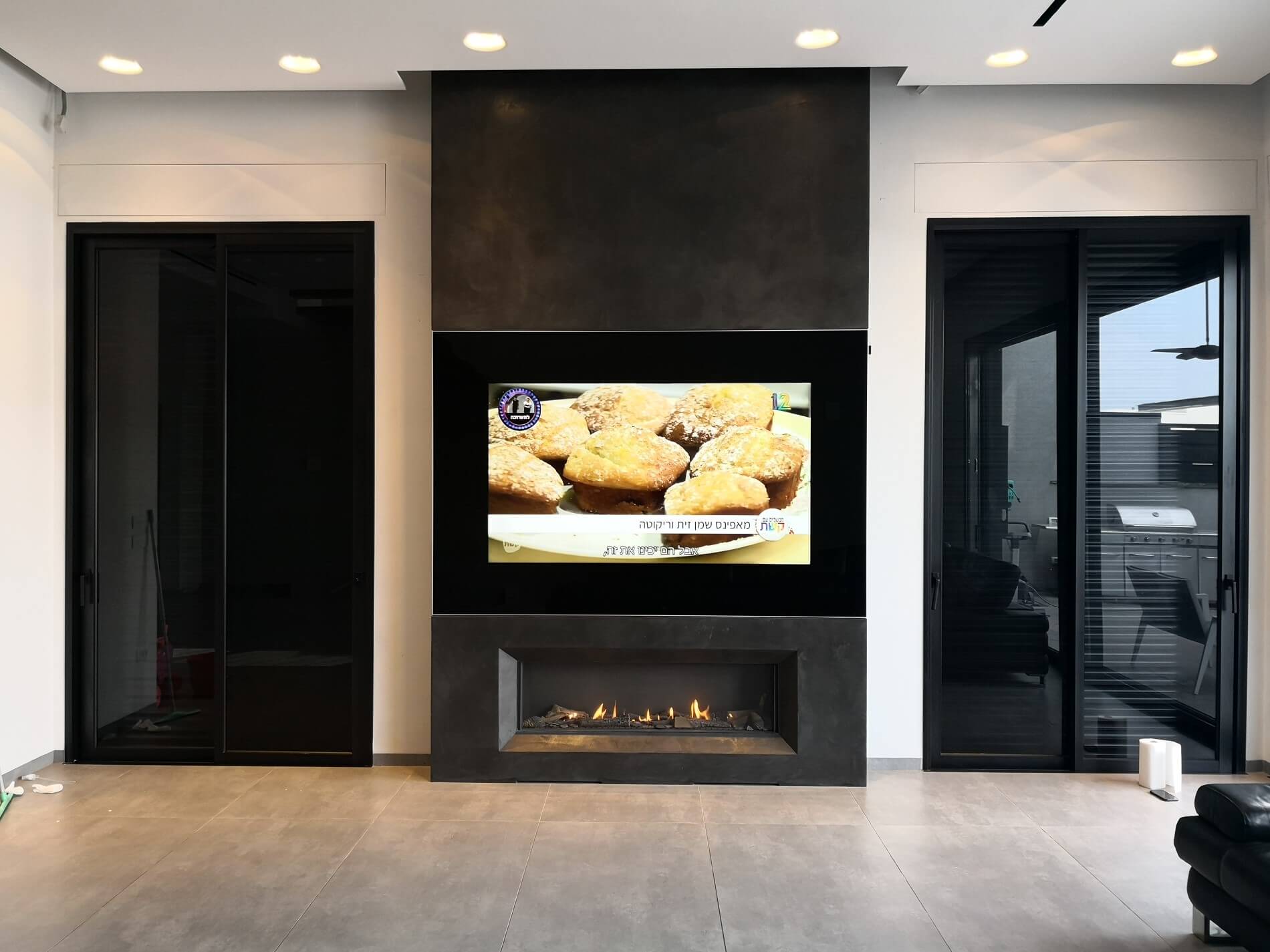
Many customers come to us after seeing one photo and saying "that is what I want in my living room". The road from the photo to your wall is shorter and more orderly than you might think — because after more than a decade and hundreds of projects, we have built a process that works: personal guidance from the planning stage, in-house fabrication from the finest raw materials, short lead times and a one-day installation.
In this article we walk step by step through the whole journey: the consultation, the measurements, choosing colour and finish, the 27 mm birch carpentry, the ultra-clear glass, installation by company employees — and the service that continues long after we leave. Full transparency, no fine print.
Start the ProcessEverything starts with a conversation. In the consultation (at your home or at ours) we get to know the space, your viewing habits and your design taste: what screen size, which devices must live inside the unit, whether to integrate an electric fireplace or architectural concrete, and what atmosphere you want in the room — dark minimalism, bright and airy, or something in between.
If you are mid-construction or renovating — we are happy to work directly with your architect or interior designer: we provide drawings, dimensions and infrastructure guidelines (power, network, mounting points) so the wall is ready for the unit before we even arrive. Joining the process early saves money and unnecessary wall openings.
At the end of this stage you hold a clear visualisation of the unit and a detailed, final quote — fair prices, no surprises later.
Tempered glass cannot be cut after production — so measurement precision is everything. A professional surveyor from our team visits, measures the wall with all its irregularities (walls are almost never truly straight), the positions of sockets and communication points, and the TV itself — model, dimensions and port locations.
At this stage the final decisions are locked in: ideal screen height relative to the sofa, equipment bay position, hydraulic front opening direction, and the concealed cable route. All data is documented in a project file that accompanies the unit from workshop to installation.
We keep your project data after handover too — so any future upgrade (a new TV, an extra device) is done on the basis of accurate, existing information.
The colour belongs to the customer — full stop. You choose the glass tone from a wide palette: deep black, graphite, smoke grey, cream, white, bronze, or a custom shade matched to your home's design language. Painting is done on the back of ultra-clear glass, so the tone arrives clean and rich — without the greenish shift of ordinary glass.
You also choose the finish — gloss (a luxurious lacquer effect) or matte (soft and modern) — and the character of the screen area: full disappearance when off, a reflective effect, or combination with other materials. You can add an electric fireplace below the screen, integrate architectural concrete at the sides, and set the tone of the decorative lighting.
Undecided? That is exactly our job. We show examples from similar projects and advise based on hundreds of installations — and the final decision is always yours. More inspiration in the gallery.
Here the magic happens. We build the unit's frame from 27 mm multi-layer birch plywood — significantly heavier and higher-grade carpentry than the furniture-industry standard. The thick birch gives the unit rigidity, dimensional stability over the years, and endurance under the cyclic load of the hydraulic front.
In parallel the glass is produced: an ultra-clear panel is cut to the exact dimensions of your wall, painted in your chosen tone, fully thermally tempered and carefully edge-polished. The inner aluminium frame, the weight-calibrated hydraulic pistons, the equipment bay and the lighting infrastructure are assembled — and every unit passes a full quality check before leaving the workshop.
Because we fabricate everything ourselves, there is no dependence on external suppliers — which translates into short lead times and a schedule we actually keep. You receive the exact date with your quote.
On installation day a Wall Screen team arrives — not subcontractors, not external installers. The same people who built your unit in the workshop are the ones anchoring it to your wall: they know every screw, every calibration and every detail of your project file.
Installation includes everything: structural anchoring, mounting the TV, connecting the set-top box, router and all equipment in the dedicated bay, full cable routing through the concealed channels, calibrating the hydraulic pistons, connecting the decorative lighting and testing the wireless remote. At the end — a complete clean-up of the work area.
In most projects, by the evening of installation day you are already sitting in front of a perfect wall, watching TV. We do not leave until everything works, is explained and demonstrated — including opening and closing the front with your own hands.
Handover is not the end of the relationship. You receive a full warranty on the product and the installation, and a team that answers a year later and five years later. Thanks to the hydraulic patent — most routine actions (swapping a set-top box, connecting a device, internal cleaning) you will do yourself, without waiting for anyone.
We also keep all your unit's data, so if you ever want to upgrade the TV, add equipment or refresh a tone — we know exactly what is on the wall and what is needed. That is what real guidance looks like, from planning until years after installation.
Transparency is part of the service, so here is the full picture. Duration varies with project complexity, but the structure is fixed — and prices are fair compared to any alternative at a similar finish level:
| Consultation & quote | First meeting free and non-binding; a detailed, final quote |
| Measurement | A professional surveyor visit; full documentation in a project file |
| Fabrication | In our own workshop — short lead time, exact date fixed in the quote |
| Installation | Usually one working day, by company employees only |
| Payment | Staged by milestones, no surprises and no deviations from the quote |
| Warranty & service | Warranty on product and installation + ongoing support after handover |
What affects the price? Screen and wall size, glass type and finish, and additions such as a fireplace or material combinations. Full details on the glass cladding price page (Hebrew).
There are carpentries offering "something similar". The difference lives in the details that last for years: tempered, polished ultra-clear glass rather than ordinary glass; 27 mm birch rather than thin board; a patented hydraulic opening rather than a fixed front; installation by company employees rather than a subcontractor; and real guidance from planning until after installation — not "goodbye" on handover day.
We have been active for more than a decade, and the first units we installed still look new — because glass has no wear, and our fabrication has no shortcuts. That is our promise, and it is written into every quote. Ready to start? Contact us for a consultation.
A Wall Screen quote is a working document, not a number on a napkin. It includes: the unit's full specification — dimensions, glass type (tempered ultra-clear), tone and finish, the 27 mm birch frame construction, details of the hydraulic opening mechanism and the equipment-bay contents; a description of the installation works — anchoring, screen mounting, equipment connection, cable routing and lighting; a schedule with a delivery date; staged payment terms; and the warranty terms for product and installation.
What you will not find in it: "mandatory options", additions appearing midway, or vague wording. The price in the quote is the price on the final invoice. That is how we have worked for more than a decade. A tip for comparing quotes: ask every supplier for exactly the same breakdown. A cheap quote that hides the glass type, the carpentry thickness or the installer's identity is not cheap — it is just not transparent.
New construction: the ideal scenario. We join at the drawings stage, define exact infrastructure (power, network, wall reinforcement) with the architect and electrician, and the unit is installed as the final finish — clean and perfect. Renovation: we integrate into the contractor's schedule; infrastructure is prepared during the works, and installation happens after painting — so the unit is never exposed to construction dust.
An existing apartment, no renovation: this works beautifully too — in fact it is most of our projects. The unit is planned around the wall's existing points, cabling runs inside the body of the unit (no wall opening, no dust), and the whole installation takes one working day with a full clean-up. By evening you are already watching. In every scenario the principle is the same: we adapt to your project — not the other way round.
08:30 — the team arrives, lays floor protection and a clean work path from the door to the wall. 09:00 — marking, levelling and structural anchoring of the unit body; a strength check before moving on. 10:30 — mounting the TV, connecting power and HDMI, assembling the equipment bay: set-top box, router, streamer — each to its place, each cable to its channel.
12:30 — mounting the glass front on the hydraulic door, calibrating the pistons to the exact weight, tuning the perimeter gap to perfect uniformity. 14:00 — connecting the decorative lighting, configuring the wireless remote, and testing: picture, sound, remotes through the glass, temperatures, and dozens of open-close cycles. 15:30 — full clean-up, personal walkthrough — including opening the front with your own hands — and handover. That is the whole day. No "we'll come back tomorrow", no boxes left in the living room.
1. Which glass exactly? The right answer: tempered, polished ultra-clear, with numbers. 2. How do I access the screen after installation? If the answer includes "a technician" — keep looking. 3. What is the frame made of? 27 mm birch is a different league from thin board. 4. Who installs? Company employees or a subcontractor — the difference is unified responsibility.
5. Where will the set-top box and router live? No planned answer means visible cables. 6. What is the lead time, and what if it slips? A written date beats a verbal promise. 7. What does the warranty cover? Product only, or installation too? 8. Can I see an installed unit? A supplier proud of their work will be glad to show it. We happily answer all eight, in writing and in person — because when the product is truly good, transparency is not a risk; it is the best sales tool. Come ask us.
We have no "order centre" passing you between parties. The people you meet along the way are one team: the consultant guiding your planning knows the workshop from the inside; the surveyor who visits works directly with the production floor; and the installers — company employees — are the ones who assembled your unit with their own hands a few days earlier.
This continuity has enormous practical value: no information is lost between "departments", there are no surprises on installation day, and the installer never sees your unit for the first time in your living room. And it is also the secret of the after-sales service: when you call a year later, the person answering knows your unit personally. That is what a company that manufactures, installs and stands behind its product looks like — for more than a decade now.
You receive a full walkthrough on handover day, but here is the digest. Daily use: nothing to remember — watch, switch off, enjoy. Remotes work through the glass, and the lighting is controlled by its dedicated wireless remote. External cleaning: a microfibre cloth and glass cleaner, as often as suits you. Internal cleaning: open the hydraulic front, wipe the inner glass and the screen, close — two or three times a year is plenty.
A new device: open, plug into the free socket, dress the cable, close. A TV upgrade: call us or do it yourself — the full opening makes the swap simple. A question or fault: one phone call, and someone who knows your unit personally is already on it. Your project file is kept with us forever. That is all — there are no more clauses, because there is nothing more to maintain.
In a world of disposable furniture, a glass cladding unit is the opposite statement: one product, built right once, serving for decades. No plastic that yellows and gets binned, no boards that swell and get replaced, no passing fashion — glass in a classic tone and quality birch carpentry simply do not go out of date.
Even as life changes, the unit adapts instead of being discarded: a new TV fits the same frame; equipment rotates through the bay; even a design refresh is possible in coordination with us. The investment spreads over so many years that the true cost per year is lower than any "cheap" solution replaced again and again. Perhaps that is the thought to end the process with: you are not buying furniture — you are upgrading a wall of your home to the level of architecture. We would be glad to start together.
A good process is one where each side knows its role. Your part is short: at consultation — tell us how you live with your TV: who watches, when, on which devices, and what matters to you in design. No preparation needed; our questions draw out everything required. At measurement — an hour at home, with the TV (if you have one) available for measuring. At selection — one enjoyable decision: tone and finish, from physical samples we bring to you.
On installation day — clear access to the wall (we move furniture together if needed) and your presence for the handover at day's end. That is it. Everything else — coordination, fabrication, transport, connections, clean-up — is on us. Customers are surprised how easy the process is on their side. That is exactly the intention: you chose to upgrade your home — not to take on another job.
Our lead time is short for the industry. After measurement and design approval, the unit is fabricated in our own workshop and usually installed within one working day. An exact delivery date is given with the quote — and we keep it.
Yes, routinely. We provide drawings, dimensions and infrastructure guidelines already at the planning stage, so the wall is ready for the unit in advance. Joining early saves costs and unnecessary wall openings.
The colour is your choice: black, graphite, cream, white, bronze or any custom shade, in gloss or matte finish. Painting is done on ultra-clear glass so the tone arrives exact and clean.
A carpentry frame of 27 mm multi-layer birch plywood, a tempered and polished ultra-clear glass front, an inner aluminium frame and hydraulic pistons — premium raw materials only, fabricated in-house in our workshop.
Company employees only — the same team that built the unit in the workshop. No subcontractors. Installation includes anchoring, mounting the screen, connecting all equipment, concealing the cabling, calibrating the mechanism and a full clean-up.
In most cases no special preparation is needed — we work on an existing wall. If power or network points are required, we define them in advance at the measurement stage, and for new construction we provide exact guidelines for the electrician.
The price is set by screen and wall size, glass type, finish and additions (fireplace, concrete combination). Our prices are fair and the quote is final and itemised — no surprises.
We are here. There is a full warranty on the product and the installation, and your project file is kept with us for any future upgrade. And thanks to the hydraulic opening — most actions you can do yourself, no technician needed.
Leave your details and we will get back to you with a personal quote for a glass TV cover — from planning to after-sales care.